Nine Linked Rings Move Sequence and Gray Code
Nine Linked Rings looks like a hand puzzle, but the move sequence is easier to understand if you treat it like a state machine.
Each ring is either in one condition or another. Write those conditions down as digits, and a physical puzzle position becomes a readable string. Make one legal move, and one part of that string changes.
That is the bridge to Gray code.
Try the Idea
Start with a tiny version in your head. Imagine each ring is written as 1 when it is on the handle and 0 when it is off. A full position can then look like a short binary-style word.
The source chapter uses examples like 1101000, 1101001, and 1100111 to show how puzzle states can be recorded. The exact convention matters less than the habit: stop seeing only metal and motion, and start seeing states.
Open the Nine Linked Rings hub and watch the state string change as the stepper moves.
Code redraw from source diagrams
A hand puzzle becomes a state string
The source plate shows rings, bars, and binary-like labels. The web version should make the transition readable: one legal move changes one visible part of the state.
The Move Rule Behind the Sequence
The puzzle is constrained. Ring 1 is special. Rings 1 and 2 can sometimes move together, depending on the counting convention. Later rings are stricter: to move a later ring, the ring just before it must be in place, while the smaller rings before that must be cleared.
That rule creates the long, nested feeling of the puzzle. To move a larger ring, you first prepare a smaller pattern. To prepare that pattern, you prepare an even smaller one.
This is why the puzzle feels recursive. You are not merely doing a long list of actions. You are repeatedly building the exact state that makes the next move legal.
Where Gray Code Enters
Gray code is a way of ordering codes so that neighboring entries differ in only one digit.
That property is the important part here. In a normal binary count, several digits may flip at once when you go from one number to the next. In Gray code, only one digit changes. That makes it useful in communication and engineering contexts where one-change-at-a-time behavior reduces ambiguity.
Nine Linked Rings has a physical version of the same idea. A legal step changes one ring state. The next legal step changes one ring state again. The source uses this one-change-at-a-time structure to connect the puzzle sequence with Gray-code thinking.
For a reader, this is the cleanest takeaway: Gray code gives a language for describing why the ring sequence is orderly instead of random.
Fast Count, Slow Count
Move counts depend on what you count as one move.
The source gives a fast convention where rings 1 and 2 may be moved together as one step. Under that convention, removing all nine rings takes 256 moves.
It also gives a slow convention where rings 1 and 2 are counted separately. Under that convention, the same nine-ring removal takes 341 moves.
Both numbers can be meaningful. They answer slightly different counting questions. If someone quotes a Nine Linked Rings move count without naming the convention, the number is missing context.
A Historical Caution
The source asks a tempting question: did Nine Linked Rings influence the invention of Gray code?
It gives reasons the question is not absurd. Nine Linked Rings is much older than modern Gray code, and the puzzle was known outside China. But the source also says Frank Gray himself did not claim Nine Linked Rings as the source of his idea.
So the careful version is this: Nine Linked Rings and Gray code have a strong mathematical correspondence, but direct historical influence should remain an open possibility, not a stated fact.
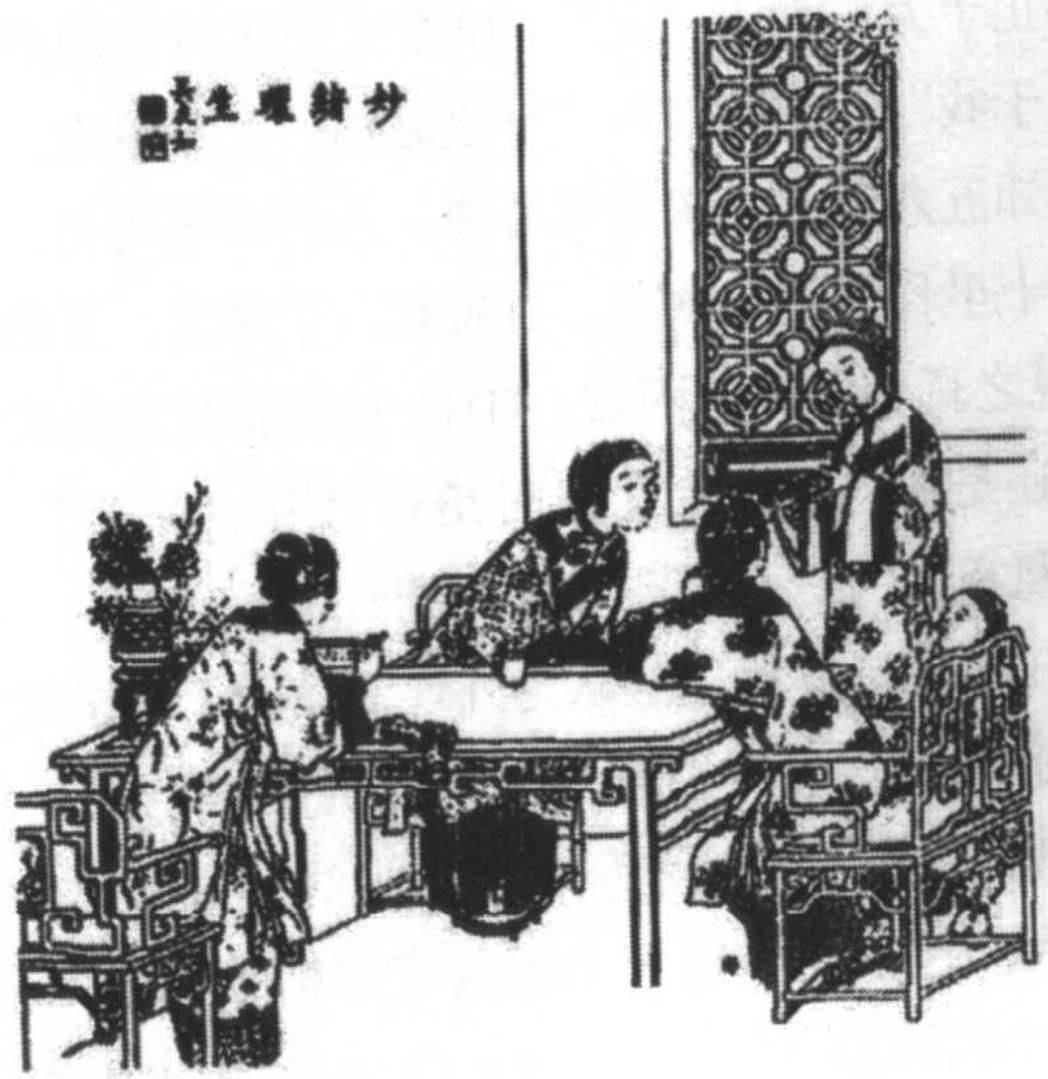
The scene gives the puzzle a human setting that a clean diagram cannot replace.
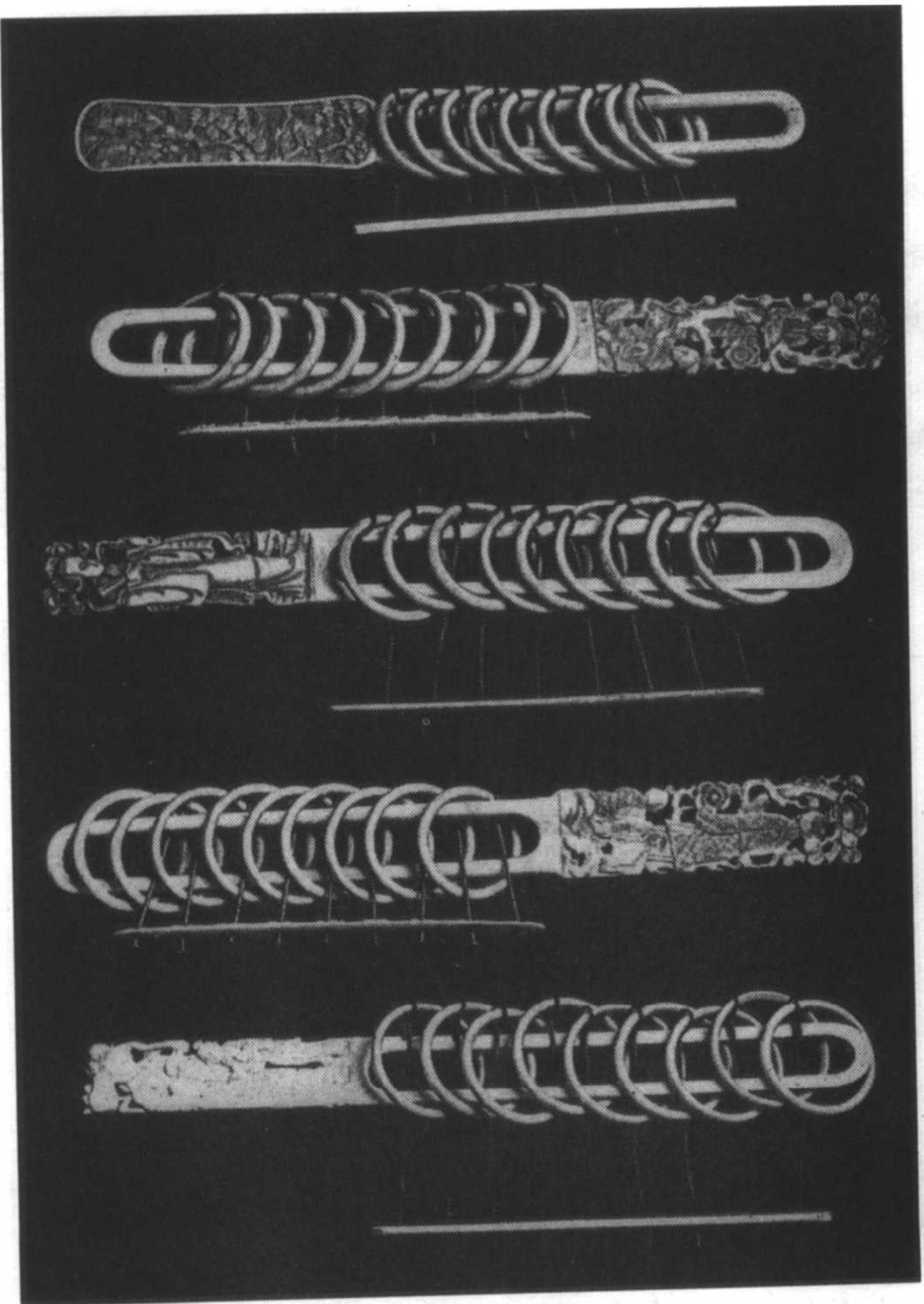
The object photo is rough, but the carved handles and repeated rings are exactly the point.
Why It Still Matters
Nine Linked Rings is a good example of why old puzzles belong in a modern math-and-AI resource.
You can hold it as an object. You can solve it as a patient sequence. You can describe it as a string of states. You can compare that string to Gray code. You can ask a program to generate legal moves.
That stack of views is the whole point: the same puzzle can be craft, history, mathematics, and computation at once.
Source Note
This article is adapted from Chinese source material in the Eastern Puzzle Archive content pipeline, especially the Nine Linked Rings chapter, source pages 162-193. The source supports the state notation, fast and slow move-count conventions, Gray-code comparison, and historical caution about possible influence. The plain-English state-machine framing is editorial explanation.
Related
- Open the Nine Linked Rings hub
- Read the Nine Linked Rings source guide
- Read Nine Linked Rings and Binary Thinking
Correction
If you notice a factual, translation, attribution, or mathematical issue, contact hello@easternpuzzle.com.