
What Is a Tangram?
A tangram is a seven-piece shape puzzle cut from a square. With the same seven pieces, you can build animals, people, letters, abstract forms, and geometric figures. Nothing is added or removed. The outline changes, but the total area stays the same.
That is why Tangram is more than a simple shape puzzle. It is a compact way to play with geometry.
Try the Idea
The fastest way to understand Tangram is to move the pieces yourself.
Start with the square. Break it into seven pieces. Then try to make one recognizable silhouette without overlapping pieces. Notice what stays fixed: the pieces, their area, and their angles. Notice what changes: the outline.
Try the full interactive board on the Tangram puzzle hub.
The Seven Pieces
A standard Tangram set contains:
- two large isosceles right triangles;
- one medium isosceles right triangle;
- two small isosceles right triangles;
- one square;
- one parallelogram.
The pieces are simple, but they are not arbitrary. Their edges and angles come from a square divided along a small set of chosen lines. Much of the puzzle's visual richness comes from that constraint.
In practical terms, Tangram is also easy to make. The Chinese source material notes that a simple set can be cut from cardboard with scissors, while a more durable set can be made from thin wood. That ease of making helped it travel beyond elite collections and become a common object of play.
Why It Feels Mathematical
Tangram works because every piece belongs to the same geometric system.
The triangles are isosceles right triangles. The square has right angles. The parallelogram follows the same 45-degree structure. The source text explains that the pieces' angles are all multiples of 45 degrees.
Another useful way to understand the set is to imagine the whole puzzle as sixteen equal small right triangles. Rearranging the seven pieces changes the silhouette, but not the total area. A square becomes a dog, a person, a bird, or an abstract form, while the amount of space remains fixed.
For a beginner, Tangram teaches geometry without announcing itself as a lesson. You move pieces, test edges, rotate shapes, and gradually discover area, symmetry, and transformation through play.
Where Tangram Came From
Tangram is widely treated as a classic Chinese puzzle, but its exact inventor and date are uncertain. The source material is careful on this point: ancient records do not preserve a clear invention story.
One commonly cited lineage connects Tangram to earlier Chinese systems of modular tables and shape arrangements. The Song-dynasty scholar Huang Bosi designed a system of rectangular banquet tables known through the Yan Ji Tu. These tables could be separated and recombined into many forms.
Later, in the Ming dynasty, triangular butterfly-wing tables appeared. These could form squares, rectangles, octagons, rhombi, S-shapes, and other configurations. Tangram, with triangles, a square, and a parallelogram, can be understood as part of this broader history of recombining simple shapes into many possible forms.
But Tangram differs from those earlier table systems in an important way. It is no longer banquet furniture. It becomes a puzzle object.
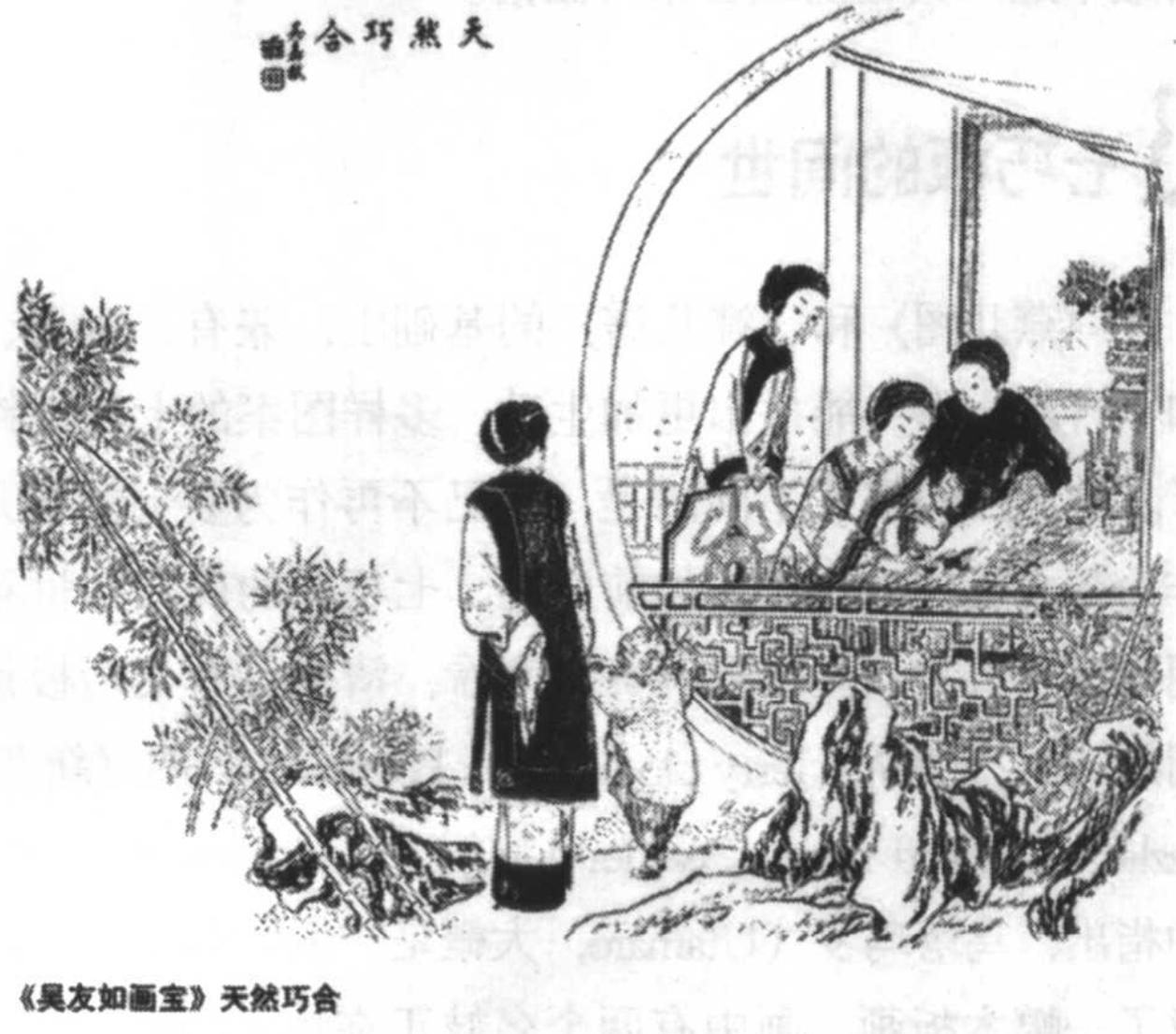
This plate is useful because it carries the atmosphere of the source tradition. Re-generating it would make the history feel less honest.
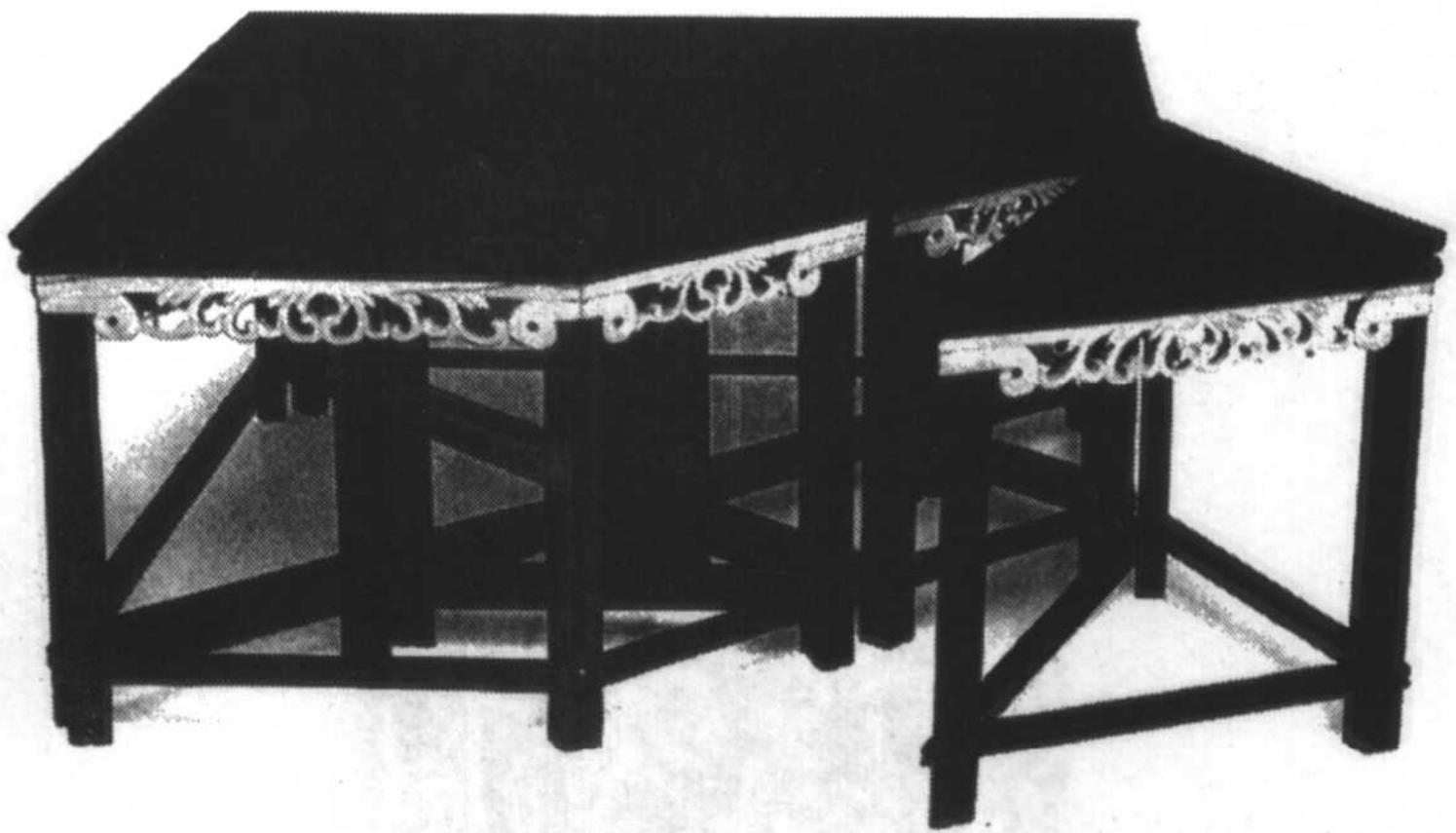
The furniture lineage helps explain why Tangram belongs to a longer habit of recombining simple shapes.
A Puzzle Book Object
The source material treats Tangram's existence by the early Qing period as well supported, while still leaving the exact invention story open.
It also cites Slocum and Botermans' Puzzles: Old and New, which mentions an 1780 woodblock print attributed to Utamaro showing people playing Tangram. Because that detail is cited through another book here, it should be read as a secondary reference, not the whole origin story.
The same source notes that dedicated Tangram books appeared during the Jiaqing period, from 1796 to 1820, though the exact earliest author and title are disputed. This is a useful reminder: Tangram's history is not a single clean origin myth. It is a trail of objects, diagrams, books, and patterns.
Why It Still Matters
Tangram remains useful because it sits between play and formal thinking. Children can treat it as a silhouette puzzle. Designers can see it as a study in shape language. Mathematicians can ask stricter questions about area, edge contact, classification, and transformation.
The same seven pieces can be used casually, artistically, or formally. That range is the reason Tangram still feels alive.
Source Note
This article is adapted from Chinese source material in the Eastern Puzzle Archive content pipeline, especially the chapters "七巧板简史", "七巧板的制作", and the opening of "七巧板数学". It has been translated, edited, and rewritten for English readers, with mathematical explanations added for clarity.
Related
Correction
If you notice a factual, translation, attribution, or mathematical issue, contact hello@easternpuzzle.com.